Arctic Glaciers Melting Expose New Coastlines, Raising Tsunami Risks

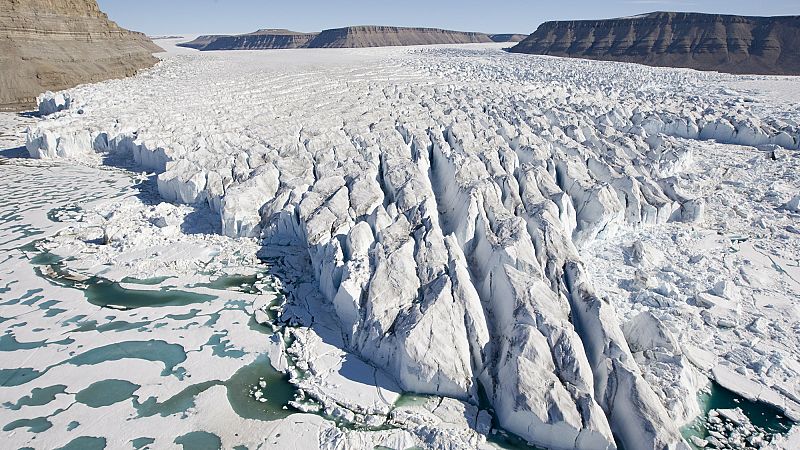
New research reveals that retreating glaciers have unveiled approximately 2,500 kilometers of coastlines and 35 previously unknown islands in the Arctic from 2000 to 2020.
Researchers analyzed satellite imagery of over 1,700 ice caps across Greenland, Alaska, the Canadian Arctic, the Russian Arctic, Iceland, and Svalbard throughout this two-decade span.
Their findings indicate that 85 percent of these glaciers have been retreating, revealing approximately 123 kilometers of newly exposed shoreline each year.
According to Dr. Simon Cook, a senior lecturer in environmental sciences at the University of Dundee, this is "profoundly changing the character of Arctic landscapes."
The study, featured in the journal Nature Climate Change Links the increase in glacier melting to higher ocean and air temperatures.
The majority of the newly formed coastlines can be seen in Greenland.
With rising global temperatures, glaciers are undergoing accelerated melting. The lower part of the glacier, referred to as the 'terminus', starts to thaw, reducing the total length of the ice mass.
Marine-terminating glaciers - which empty into the sea - frequently uncover new sections of shoreline as they thaw.
Using satellite images from 1,704 ocean-facing glaciers in the northern hemisphere, the scientists documented a 2,466-kilometer stretch of newly uncovered coastlines between the years 2000 and 2020.
The research indicates that the pace at which new coastlines are uncovered differs considerably across various areas.
The researchers discovered that over fifty percent of the increased coastline length was attributed to just 101 glaciers.
Two-thirds of the newly formed coastlines were situated within Greenland. retreat The Zachariae Isstrom glacier in the northeastern part of the nation created 81 kilometers of new coastline – over double the amount compared to any other glacier in the research.
The researchers discovered 35 new islands, each covering more than 0.5 square kilometers, as melting glaciers exposed them. These islands had either been entirely hidden beneath ice or disconnected from the main landmass previously.
Rising sea and atmospheric temperatures, spurred by climate change, are primarily driving marine-terminating glaciers to retreat. rapidly lose mass , the study says.
The recently revealed shoreline raises the likelihood of landslides and tsunami occurrences.
The researchers caution that "the withdrawal of marine-terminating glaciers changes the terrain and also indirectly threatens local populations and coastal economic activities."
The newly uncovered coastlines - known as ‘paraglacial’ - are more susceptible to landslides, which can then trigger “dangerous tsunamis ”.
The research underscores the tsunami that struck Greenland in June 2017, resulting in significant destruction of property and casualties.
"Environmental science lecturer Cook explained that paraglacial coastlines vary from other parts of the Arctic shoreline since permafrost has not yet formed in these newly exposed regions. As a result, they are prone to greater erosion from waves, landslides, and other processes due to the absence of frozen soil acting as a stabilizing agent," he noted. article For Nature Climate Change, "These systems are thus anticipated to exhibit high levels of dynamism."
The researchers point out that this situation also presents safety hazards for visitors who are drawn to coastal glacier regions because of their attractiveness and rich biodiversity.
"Campsites and tourist activities near coastlines close to major iceberg transit paths are at risk due to iceberg roll waves," they explain.
“Beyond the health and safety hazards posed by severe waves, the tourism sector could also suffer significantly as marine-terminating glaciers transform into land-terminating ones, altering the aesthetic appeal of the landscape.”