Chinese food and beverage chains win fans in Southeast Asia

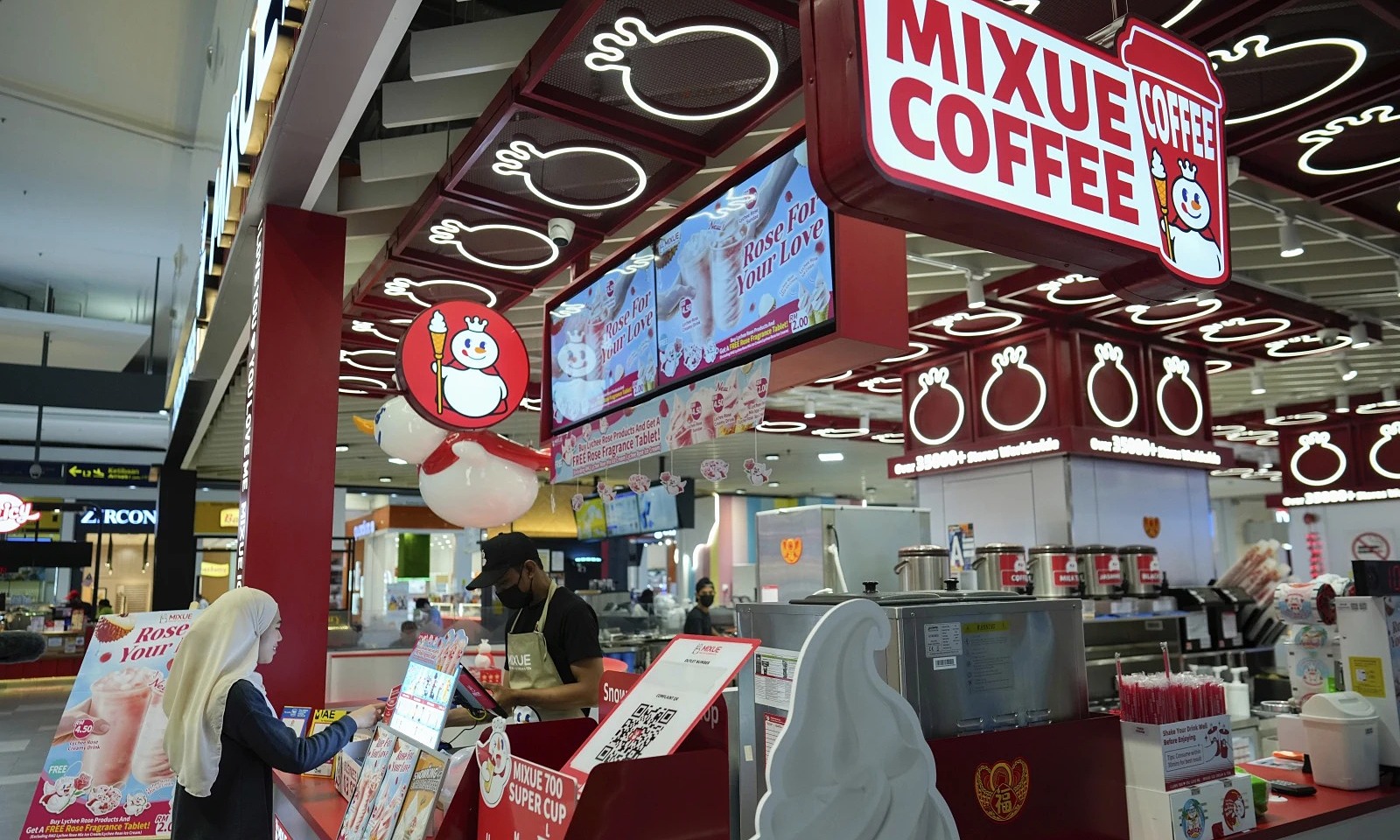
Chinese food and drink brands are making significant strides throughout Southeast Asia, providing viable options to prominent U.S. chain restaurants and broadening China’s economic and cultural impact on nearby markets.
The prominent Chinese drinks company Mixue Group has surged past Starbucks and McDonald’s to claim the title of the globe’s leading food and beverage franchise based on store count.
The company, whose brand name Mixue Bingcheng means "Honey Snow Ice City," in Chinese, is capitalizing on the region-wide sweet tooth with affordable offerings of ice cream, coffee and bubble tea drinks.
"Even on platforms such as TikTok and others, there’s a joke suggesting that every vacant shop will quickly become a Mixue outlet," explained Rahma Yuliana, referencing a common phrase in Indonesia, where Mixue boasts over 2,600 locations.
A working mom who operates an internet-based company often spoils her child after school with affordable goodies like a cup of brown sugar milk tea priced at $1.10, which is roughly 30% less expensive compared to what rivals like Taiwan's Chatime offer. She can also get an ice cream cone starting from just 50 cents, making it more budget-friendly even when compared to fast-food giants like McDonald’s.
By September, Mixue Group operated through more than 45,000 outlets selling their Mixue beverages, ice creams, and Lucky Cup coffee items, surpassing the outlet counts of both Starbucks and McDonald’s, according to industry experts. Approximately 40,000 of these locations were within China.
By December, according to reports from Singapore-based research firm Momentum Works, Chinese food and beverage companies had established more than 6,100 stores across Southeast Asia.
Approximately two-thirds of the market share is held by India and Vietnam, whereas China has a stronger presence in Singapore and Malaysia due to their substantial Chinese-speaking communities.
Nearly all of Mixue’s stores are franchises that the company supplies with ingredients for drinks like Creamy Mango Boba, Mango Oats Jasmine Tea and Coconut Jelly Milk Tea. Apart from Mixue, other market stars include hotpot giant Haidilao, Fish With You sauerkraut fish restaurants, and well-known beverage brands such as Luckin Coffee, Heytea and Chagee.
Jianggan Li, the CEO of Momentum Works, stated that Chinese companies are aggressively exploring fresh opportunities for expansion within Southeast Asia following intense rivalry in their domestic markets.
The initiative led by food and beverage sellers has highlighted that China can provide much more than inexpensive electronics.
Li mentioned that these businesses are well-prepared, leveraging automation to boost their productivity and excelling in digital advertising strategies.
Big Western brands sometimes take a long time to find local partners and develop long-term plans. The Chinese F&B companies are "much more impatient," he said.
In Bangkok, the capital of Thailand, Chinese businessman Siya Han has committed more than $1.37 million to establish 12 Mixue locations along with approximately 10 additional establishments offering spicy soup bowls, pickled cabbage fish, and breaded chicken fillets within roughly six years.
She mentioned that stores located in shopping centers require considerable time to recuperate expenses because of substantial rental deposit requirements. However, her other locations generally reach the point of breaking even within half a year to one year, not factoring in any lease guarantees they might have.
As she put it, 'If you expand Chinese restaurants too gradually, you won’t make it,'
In Malaysia's capital city, Kuala Lumpur, Liu Liujun—the vice president of the Chinese pickled cabbage fish restaurant chain Fish With You—recognized an opening due to the substantial Chinese diaspora and expanding economies in Southeast Asia.
The company's $235,000 investment in one of its branches in Malaysia yielded returns within only nine months, as queues formed daily at the outlet nearly every day, noted Liu, who manages the firm’s international growth throughout the area.
Victoria Kovalan mentioned that the introduction of new Chinese brands has facilitated her exploration of various international cuisines.
"She mentioned that it has broadened our taste preferences," she said, speaking about the rise in popularity of Sichuan hotpot, famous for its spicy tastes.
Nguyen Thu Hoai, a Vietnamese student from Hanoi, was initially doubtful of Mixue due to it being a Chinese brand. However, she now frequents their stores regularly, having been convinced by both its affordable prices and superior quality exceeding her expectations.
The expansion of Chinese food and beverage brands is part of a broader trend where Chinese goods are no longer seen as merely cheap but as having real value, said Gordon Mathews, a professor of anthropology at the Chinese University of Hong Kong.
Mathews recalled the cultural impact of McDonald’s worldwide growth, mentioning his visit to its initial location in Guangzhou, the financial center of southern China during the 1990s. There, a staff member shared with him, “I wish to go to America.”
"If Chinese food brands were to expand globally, they could potentially wield significant influence, although the full extent of this impact is yet to be determined," he stated. "While China faces challenges in building soft power, it is excelling when it comes to promoting its products," he added.